


Determination of the mixing time and power input required to achieve the required mixing quality
Rubber compounds are produced in a discontinuously working internal mixer with the addition of components such as rubber, fillers, plasticisers and other chemicals. To ensure high quality, specific mixing instructions have to be developed for each recipe. The optimal process settings are currently determined iteratively on the basis of expert knowledge. Currently these process developments take place on production machinery involving significant expenditure of materials and energy.…
 © IKV
© IKV
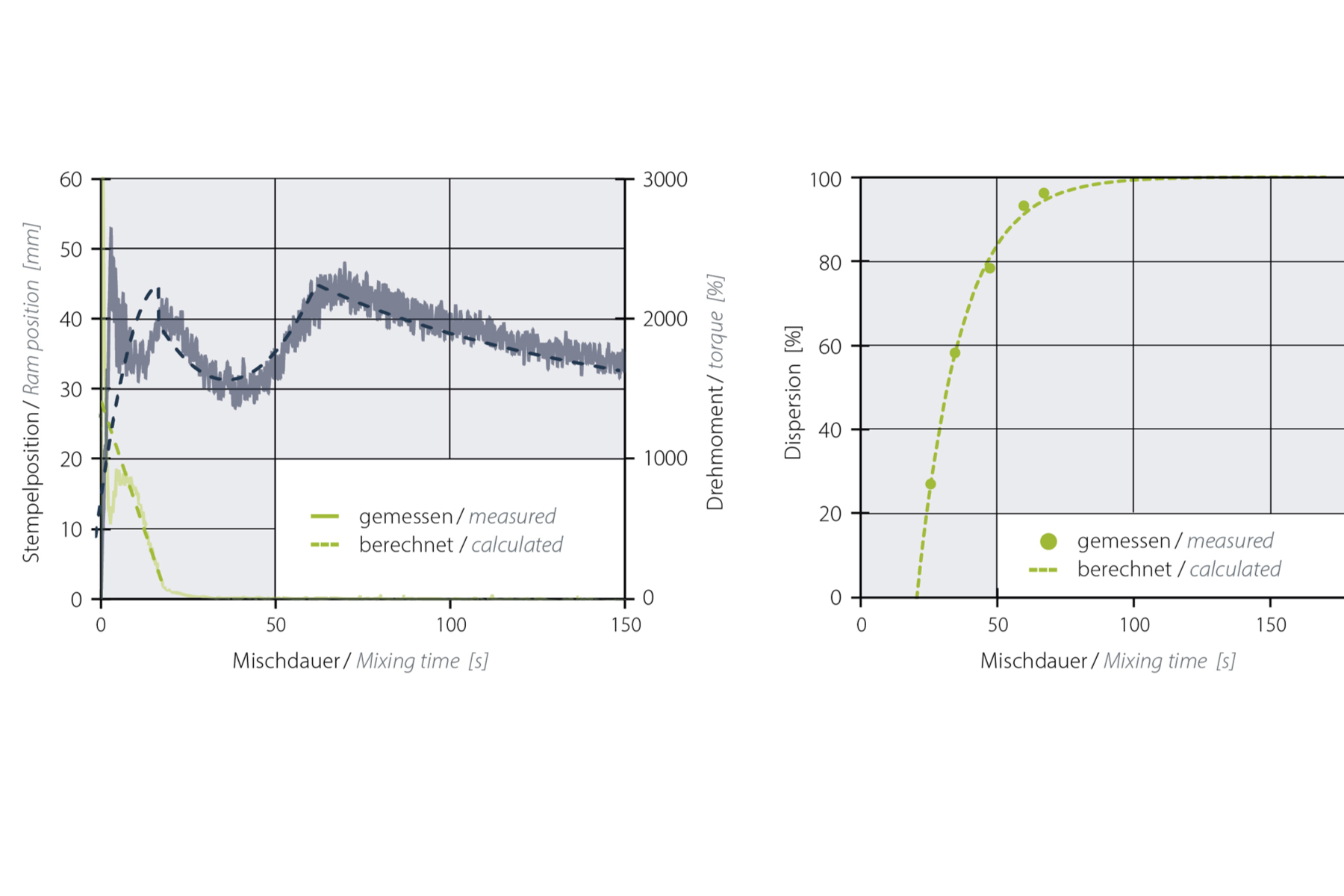
For this reason, the project aimed to develop an ‘app’ that determines the corresponding recipe and mixing instructions based on the required end-product properties. During the mixing process, both the order in which ingredients are added and the process settings have an impact on the quality of the compound.. To develop initial approaches for describing the entire mixing process, mathematical models were developed using symbolic regression, which describe the ram path and torque as well as the mixing quality based on the incorporation, dispersion and distribution of the fillers. These models were extended to include physical relationships, such as the torque as a function of shear stress. The subsequent optimisation of the models enabled a reduction in energy consumption of up to 40 %.^Q
We would like to thank the BMWE and dem BMFTR for funding the project (funding code 13XP5196G) and the project partners for their cooperation.

