


Simulationsgestützte Generierung von Kühlkanallayouts auf Basis des lokalen Kühlbedarfs
In the completed subproject B01, a simulation-based methodology was developed that enables cooling systems for injection moulds to be designed automatically and in a reproducible manner. The aim was to reduce warpage in plastic components while at the same time decreasing the effort required during mould try-out.
 © IKV
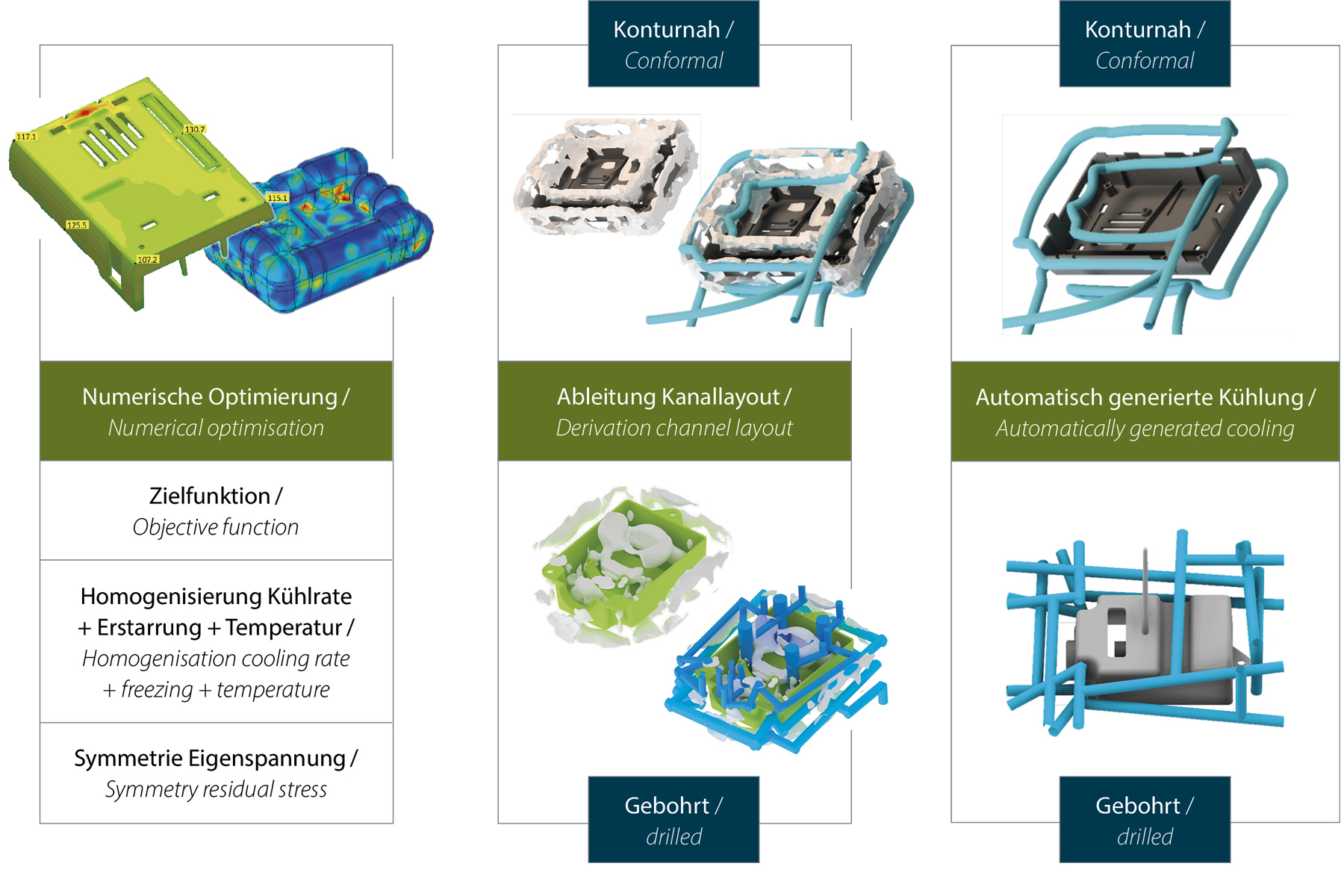
© IKVThe starting point of the work was the calculation of the local cooling demand of a moulded part. Using FEM-based simulations and specifically developed objective functions, the project analysed where more or less heat needs to be removed from the mould. Based on this optimized thermal distribution, suitable cooling channel layouts were subsequently derived. The developed objective functions evaluate temperature, cooling rate, and residual stresses during the cooling phase.
A particular focus was placed on the automated generation of different cooling systems. In addition to conformal cooling channels, which follow the contour of the part geometry, production-oriented straight cooling channels were also generated algorithmically. The figure shows an example of a straight and a conformal automatically generated cooling channel system.
Simulation-based and experimental investigations showed that automatically generated cooling channels can achieve comparable or reduced warpage. The project therefore makes an important contribution to the digitalization of mould design and demonstrates how simulation-based algorithms can contribute to more robust and efficient injection moulding processes in the future.
General Information on the SFB
Since 2014, Collaborative Research Center 1120 at RWTH Aachen University has been researching new scientific approaches and technologies for controlling processes in which the material passes through a molten phase in order to precisely manufacture the geometry. Next to metal welding, casting, and joining processes, the IKV conducted research on plastic injection molding as part of this large-scale project through three subprojects. Through the design of temperature cooling channel layouts, dynamic mold temperature control and multiscale process simulations, the project investigated melt dynamics, solidification, and methods for influencing or modeling these phenomena at various levels.
Project Data and Funding
We would like to thank the DFG for funding this project as part of Collaborative Research Center 1120 and our project partners for their collaboration.
