


Model-Predictive Control of a Highly Segmented Mold Temperature Control System for Locally Influencing Cooling Behavior and Reducing Warpage in Injection Molding
In subproject B03 of SFB 1120, a methodology was developed to influence the warpage of injection-moulded parts using highly segmented mould temperature control. The aim is to reduce component warpage by homogenising the cooling behaviour across the component.
 © IKV
© IKVFor this work, an injection moulding tool was first developed and manufactured to investigate the temperatures and pressures arising during the cooling process. For this purpose, a plate-shaped component was examined, featuring nine IR temperature sensors per mould half. In addition, three pressure sensors were installed along the flow path. To adjust the temperatures for warpage control, nine temperature control zones were also installed in each mould half, consisting of a ceramic heating element and a CO2 cooling chamber, to enable local dynamic control of the mould temperature.
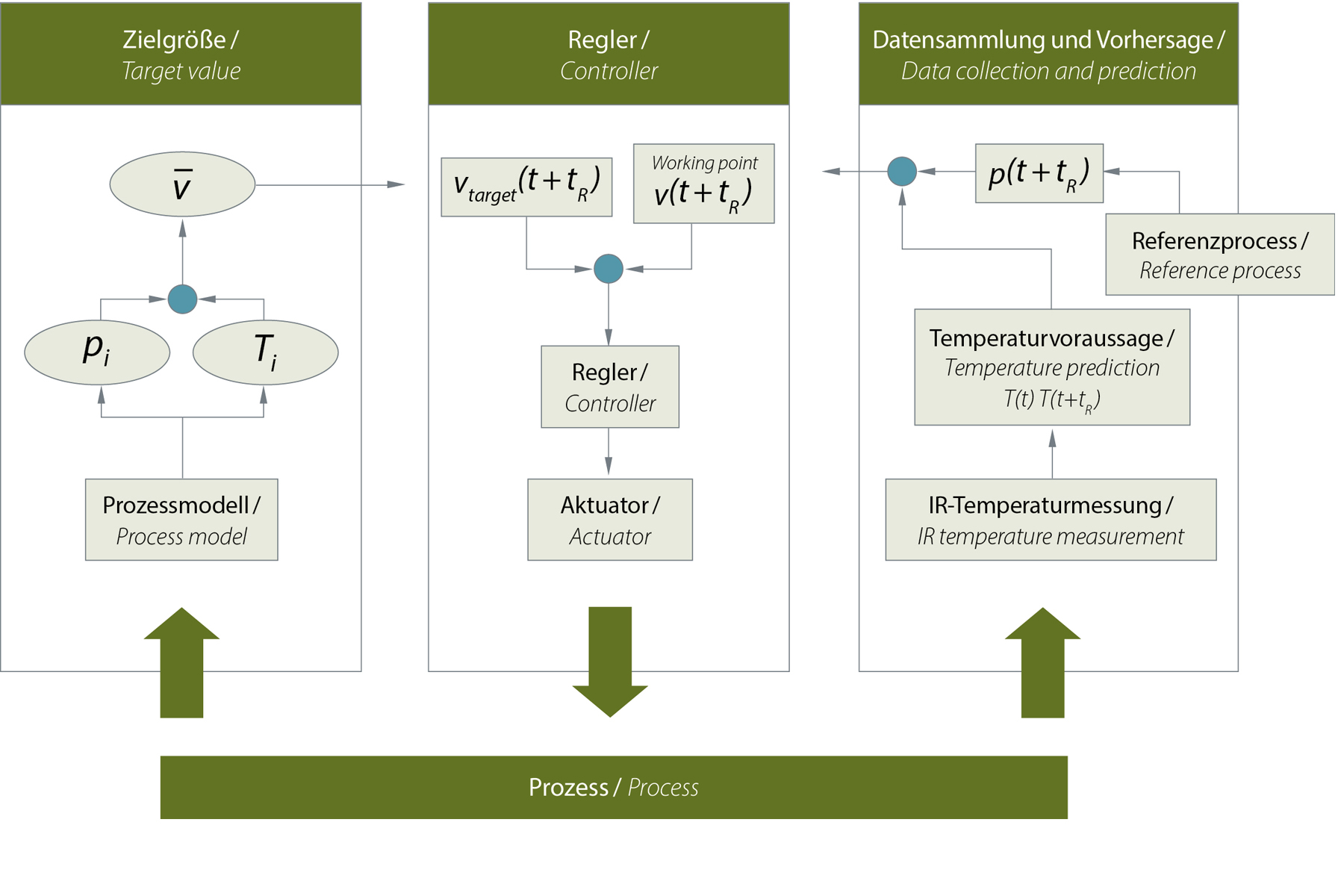
A model predictive controller (MPC) was designed based on the process data measured using the tool. The controller uses process data and a process model to predict the required heating demand for the heating layers. The control concept is illustrated in Figure 1. The MPC enables temperatures to be adjusted sufficiently quickly, even in the case of slow heating response.
Furthermore, the project investigated the transferability to a complex system. For this purpose, ceramic heating coatings, resistance heating elements with a total thickness of approximately 0.5 mm, applied to the cavity surface by thermal spraying, are used, which were developed in a further sub-project of the SFB at the Institute of Surface Technology (IOT). Simulation studies indicate a significant expected effect in reducing warpage in complex moulded parts. Overall, the project contributes to the development of new control concepts for warpage management and demonstrates a methodology for local warpage reduction that is independent of specific process points, thanks to the ability to adjust temperatures.
About SFB 1120
Since 2014, Collaborative Research Center 1120 at RWTH Aachen University has been researching new scientific approaches and technologies for controlling processes in which the material passes through a molten phase in order to precisely manufacture the geometry. Next to metal welding, casting, and joining processes, the IKV conducted research on plastic injection molding as part of this large-scale project through three subprojects. Through the design of temperature cooling channel layouts, dynamic mold temperature control and multiscale process simulations, the project investigated melt dynamics, solidification, and methods for influencing or modeling these phenomena at various levels.
Project Data and Funding
Wir danken der DFG für die Förderung des Projekts im Rahmen des Sonderforschungsbereichs 1120 und den Projektpartnern für die Zusammenarbeit.
