


Session 1 of the 33rd IKV Colloquium focuses on mechanical recycling.
The IKV is actively engaged in numerous research projects on the process engineering development of methods that improve the quality of recyclates, thereby enabling their use in demanding applications. The 33rd IKV Colloquium will address, among other topics, the opportunities and challenges of advanced mechanical recycling.
Aachen, December 2025 – In order to meet the EU requirements regarding the use of recyclates in packaging, which will come into force in 2030, comprehensive efforts are urgently needed in every step of the mechanical recycling process chain. The Institute for Plastics Processing (IKV) in Industry and Craft at RWTH Aachen University is working intensively on numerous research projects to develop processes that increase the quality of recyclates and thus enable their use in demanding applications.
The use of recyclates in new plastic products and the creation of effective material cycles make a significant contribution to achieving current sustainability goals, such as CO2 savings, preventing plastics from entering the environment and reducing the demand for fossil raw materials. One challenge is the lower quality of recyclates compared to virgin materials, which prevents their use in demanding applications such as packaging. As a result, the required recyclate quotas cannot be achieved, particularly in the packaging sector, which consumes the largest share of plastics produced in Europe.
 © IKV
© IKVIKV pursues a holistic approach to improving the quality of recycled materials in publicly and industrially funded research projects. To this end, all steps of mechanical recycling are to be optimised and coordinated and combined in such a way that each step can deliver the best possible result. IKV works closely with companies from all areas of the plastics industry. The 33rd International Colloquium Plastics Technology provides exciting insights in Session 1, Additivation, De-Inking, Coating – Building blocks for increasing the use of recyclates.
LOOPCYCLING – Advanced mechanical recycling of LDPE packaging films to achieve a truly circular economy in the field of plastics recycling
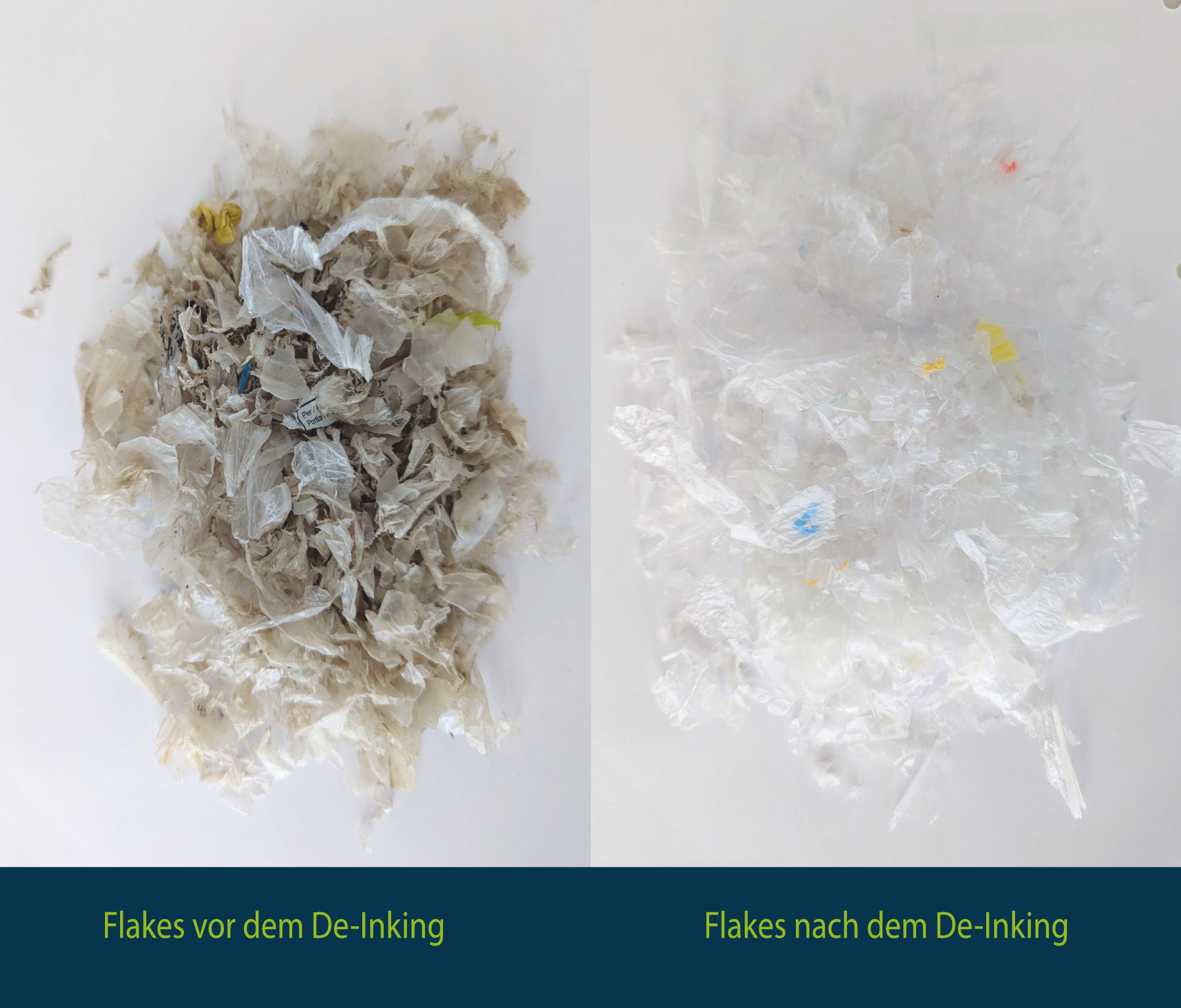
In the joint research project LOOPCYCLING, the IKV is working closely with more than 20 companies from all areas of the plastics industry to investigate the mechanical recycling of LDPE packaging films. Starting with the sorting of film waste from the German “yellow bag”, all process steps on the way to a recyclate film are thoroughly investigated, optimised and coordinated. Particular attention is being paid to de-inking to remove the printing inks from the packaging film waste. This upstream step can significantly reduce degradation and contamination of the plastics during regranulation. In addition to process engineering solutions, various compounding additives are being investigated. They are designed to minimise the degradation of plastics, bind unwanted odours and generally facilitate further processing. In the course of the process chain, the extent of contamination of the recyclates is being investigated at the IKV using suitable methods.
The consistent implementation of the best recycling strategies currently available should result in recyclates of the highest optical and mechanical quality, containing no more than minimal amounts of contaminants. One of the project’s goals is to produce recyclates from current plastic film waste from the “yellow bag” that are suitable for use in contact-sensitive packaging, e.g. for packaging hygiene and cosmetic products or even food (Figure 1).
Besides, defined film systems, which meet the current design-for-recycling specifications and are therefore considered recyclable are being investigated in the course of the project. This provides insight into the actual recyclability of the film waste stream as it will exist in Europe from 2030 onwards. A targeted selection of film systems with varying structures (front/back printing, laminates, binders, barriers, laminations, primer layers, MDO and BO-PE as well as foreign polymers) allows to link special features observed in the course of the recycling chain directly to the properties of the film, to reap further insights. This also opens up the possibility of adapting processes ideally to future packaging solutions and to take a part in shaping the design for recycling on a scientific basis.
Plasma barriers protect packaged contents from contamination
Even minimal levels of contamination can prevent the use of recyclates for contact-sensitive packaging. In addition to improving recycling processes, the IKV is therefore pursuing an approach that uses the PECVD (Plasma Enhanced Chemical Vapour Deposition) process to apply functional barrier layers that can significantly reduce the migration of harmful substances from recyclates. The plasma-assisted process applies ultra-thin layers to the surface of the packaging, providing an effective barrier against gases and contaminants. This protects the contents and enables the use of recyclates in sensitive packaging solutions (Figure 2).
 © IKV
© IKVCircular economy at the 33rd International Colloquium Plastics Technology
The colloquium will address the topic of circular economy and recyclate use in several sessions, among others in:
- Session 1: Additives, de-inking, coating – Building blocks for increasing the use of recyclates
- Session 2: Circular products through foam injection moulding
- Session 6: Mechanical recycling of CFRP: Vitrimers as enablers
- Session 7: Analysis and improvement of the quality of polyolefin recyclates
- Session 12: Processing and recycling technologies for polyurethanes
- Session 14: Processing recyclates in film extrusion
At ‘IKV 360° – Research Live’, IKV scientists bring the topic to life at various stations in the IKV technical centre.