


Industry funded consortium project
LOOPCYCLING maps the entire mechanical recycling process chain and optimises established industrial processes to interlock perfectly and deliver the best possible results for each step. To this end, the IKV works together with a consortium of industry partners.
The availability of high-quality recyclates is an important prerequisite for meeting the requirements of the EU Packaging and Packaging Waste Regulation (PPWR) regarding recyclability and the use of recycled materials. Therefore, IKV’s research in the LOOPCYCLING project, which was launched at the beginning of 2025, focuses on the optimisation of mechanical recycling, the most energy- and material- efficient plastic recycling process, using packaging films as an example.

The aim of LOOPCYCLING is to optimise the quality of industrially available LDPE recyclates from household collection, thereby making the required quantities economically available. To this end, the IKV is working with a consortium of industry partners that covers the entire mechanical recycling process chain. The starting point are industrially established processes, which are to be optimised in the sense of an Advanced Mechanical Recycling to interlock perfectly and deliver the best possible results for each step. Among other things, this should enable the use of recyclates in contact-sensitive packaging for food or cosmetics. In addition, design-for-recycling standards for packaging films are to be derived from the results.
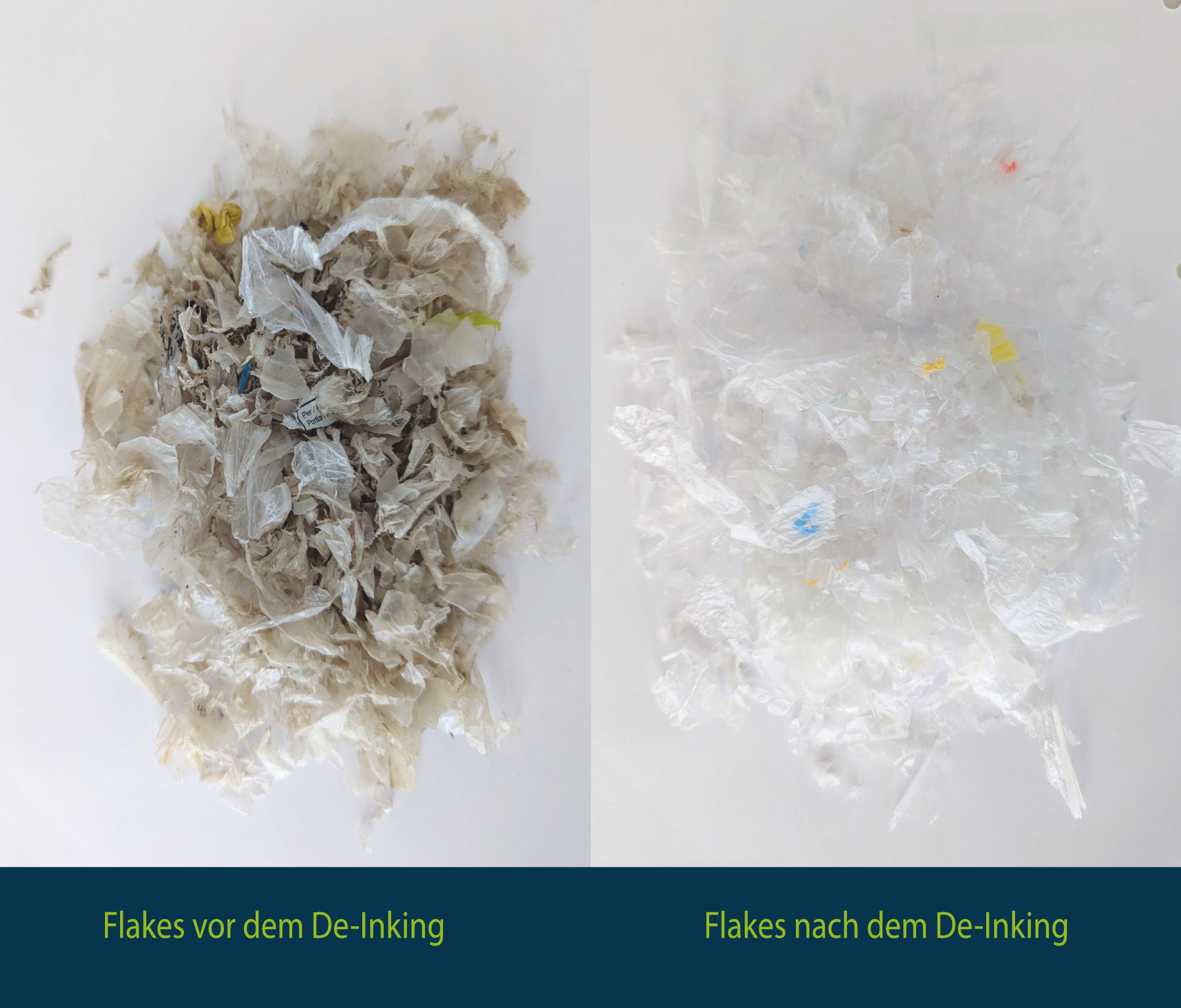
LOOPCYCLING is initially focusing on the process steps of sorting and shredding, de-inking, compounding and decontamination. State-of-the-art methods are used to sort LDPE household waste. Collected films are cut to a precise target size during sorting to maximise de-inking effectiveness. De-inking involves optimising friction washing and identifying the most effective washing additives for the complete removal of printing inks and contaminants. In addition, the project examines how film design can effectively support subsequent de-inking.
Stabilising polymers against degradation during processing and efficient decontamination are optimisation goals in compounding. State-of-the-art extrusion and decontamination equipment is being used to improve degassing, e.g. through the use of entrainers, and to maximise both deodorisation and decontamination through filtration and heat treatment. Additives play an important role in the compounding step, serving to specifically adjust material properties and minimise degradation. The project is therefore investigating various compatibilisers and processing additives as well as possibilities for functionalisation.
Initial results from LOOPCYCLING show that the classic mechanical recycling process of sorting and processing, cold washing and compounding for the production of optimised film recyclates must be expanded to include further processes: de-inking, i.e. the removal of printing inks, following cold washing, as well as degassing, filtration and additivation as additional steps in compounding. If the film produced from the recycled compound is intended for a contact-sensitive application, a recyclable PECVD coating is also recommended. The IKV is investigating such coatings in the RezyPlas project, among others, but they are not part of LOOPCYCLING.
Research partners


Project details and funding
Project start: January 2025
Term: 2 years
Funding: None as purely industry-financed project