


Bachelor’s Thesis or Master’s Thesis
 © IKV
© IKVTopic of the Thesis
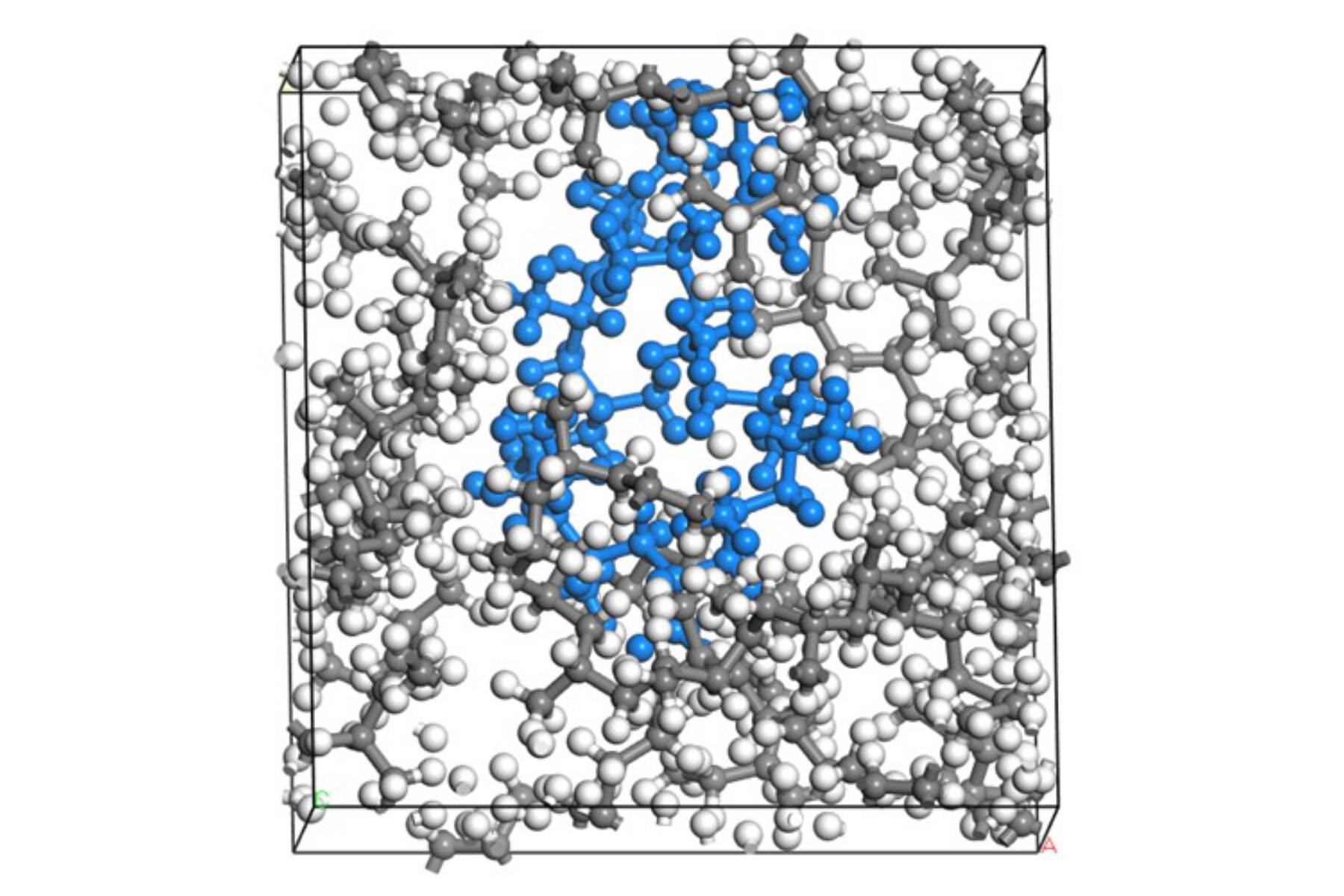
Before a molecular dynamics simulation yields a single useful result, nothing happens at first. The amorphous cell is assembled, packed, compressed, heated, cooled, and brought to equilibrium over hundreds of picoseconds. The cluster runs the calculations; you wait. And because a single cell is not statistically meaningful, this process is repeated multiple times for every combination. This equilibration is a clearly defined, highly repetitive process with known physical boundary conditions—in other words, a nearly ideal application for machine learning.
The paper is being written by this research group
In the Media Influence Research Group, we follow the Quantitative Structure-Property Relationship (QSPR) approach. The goal is to use the molecular structure of the polymer and the medium to infer the risk of environmental stress cracking (ESC). Molecular dynamics simulations provide key parameters for this, such as diffusion and interaction behavior. The number of combinations we can consider currently depends primarily on the computation time required to set up and equilibrate the cells. If we can learn this step rather than compute it, the screening can be expanded by several orders of magnitude. We use BIOVIA Materials Studio and LAMMPS on the CLAIX high-performance computer at RWTH Aachen University. We will work together to determine which approach you will take and where you will focus your research.
Objective
Develop, train, and evaluate a data-driven model that accelerates the setup and equilibration of molecular dynamics cells while accounting for physical boundary conditions.
Your Assignment
| For a bachelor's thesis, you will work on the following tasks | For a master's thesis, you will work on the following tasks |
| Familiarization with the existing workflow consisting of cell preparation and equilibration | Familiarization with the existing workflow consisting of cell preparation and equilibration |
| Systematic generation and processing of training data on the high-performance computer | Evaluation of potential approaches to accelerate and build an automated data pipeline |
| Development of an initial model for predicting the properties of equilibrated cells | Development and training of a model incorporating physical boundary conditions |
| Evaluation of prediction accuracy compared to classical simulation and estimation of the reduction in computation time | Validation on unknown polymer/medium combinations and evaluation of the achieved reduction in computation time |
Your Profile
- A degree in engineering or the natural sciences (e.g., mechanical engineering, industrial engineering, materials science, computational engineering science, simulation sciences, applied chemistry, or applied polymer science)
- Enjoyment of programming, ideally in Python
- Interest in machine learning and simulation; prior knowledge is welcome but not required
- Willingness to learn how to work on a high-performance computer
- An independent, structured, and team-oriented approach to work
Here are your benefits
- Work in a young, motivated team
- Independent work with close supervision
- Opportunity to help shape a research topic that will serve as the foundation for future work
- Individual coordination of tasks, scope, and timeframe
- Access to the CLAIX supercomputer at RWTH Aachen University
- A varied mix of research, simulation, and data analysis
- Can start immediately
If you’re interested in writing a thesis at the IKV and in this topic, please feel free to contact me. We’ll work together to determine the approach you’ll take, how deeply you’ll delve into the modeling, and what the timeline will look like, so that the thesis aligns with your interests and prior knowledge.