


Research laboratory
 © IKV
© IKVResearch Lab Topic:
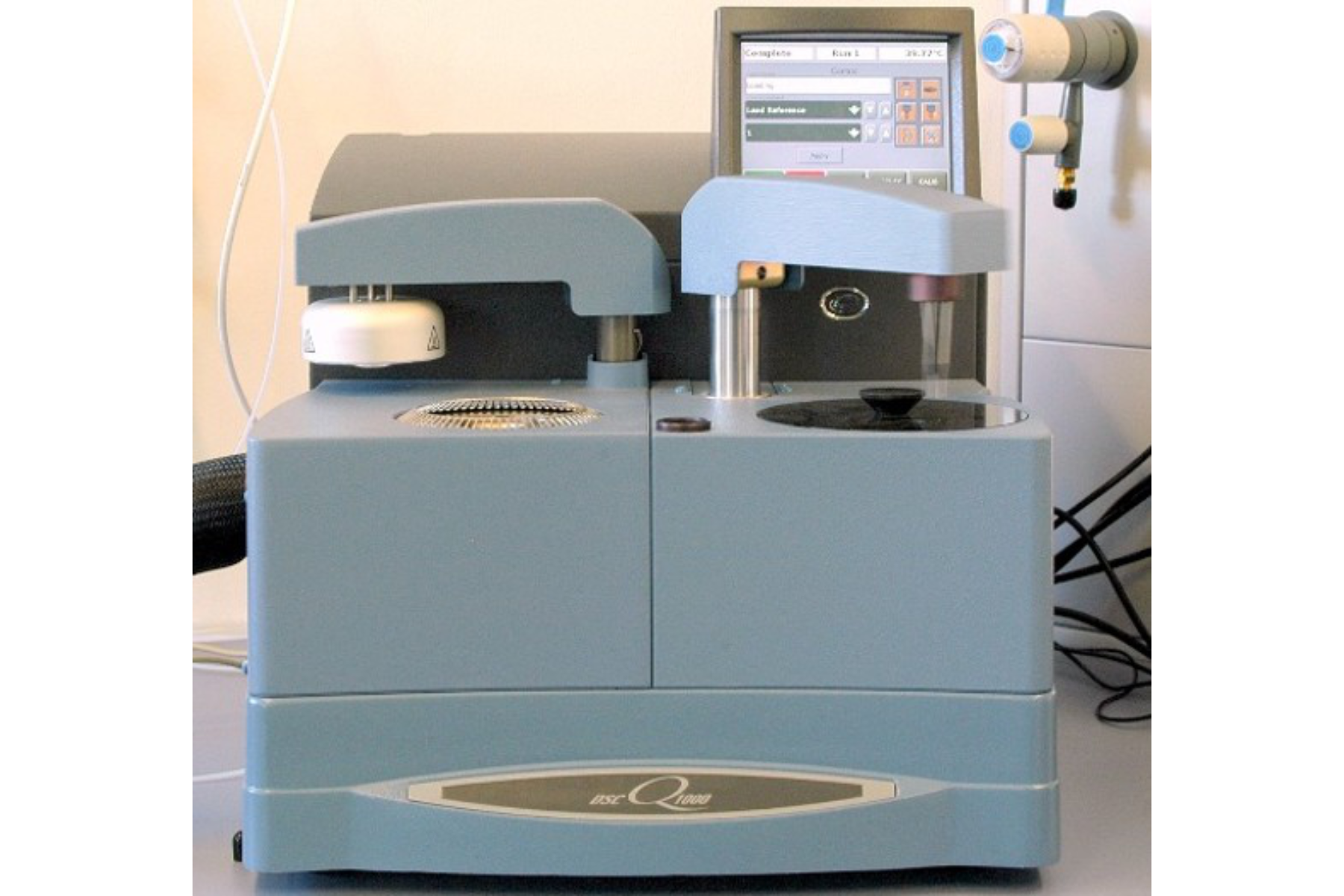
To determine the measured quantity, the standard procedure involves conducting three separate measurement runs (baseline, sapphire, and sample runs) under identical conditions. This method has the advantage that systematic errors caused by heat loss or drift are largely eliminated through direct comparison with the known sapphire standard. However, thanks to innovative sensor technologies, it is also possible to use a direct measurement ofCp for evaluation purposes. In this method,Cp is calculated directly from the heat flux signal of a single measurement. This could reduce the duration of test series by one-third.
As part of this research laboratory, a methodological evaluation will now be conducted to identify and compare variations using appropriate test series. In addition, the error tolerances should be weighed against the savings in analysis time.
The work is written in this working group:
The tests conducted in the physics laboratory of the Center for Plastics Analysis and Testing (KAP) play a key role in supporting industry- and institute-led research in the validation of manufacturing parameters. Another area of focus is the characterization of materials through thermal, spectroscopic, rheological, and chromatographic analyses, in order to evaluate material behavior and thus address not only research questions but also industrial challenges. Through these analyses, the laboratory provides essential findings for the optimization of production processes and improved component quality.
Objective:
As part of this research lab, the heat capacity of a system will be compared using two different measurement methods. In this process, the heat capacity is determined once by direct measurement and once using the three-curve method.
Your task:
The results of both methods will then be compared to assess any possible discrepancies, as well as the accuracy and reliability of each method.
In addition, this research laboratory will investigate which measurement method yields more suitable or more precise results under the given experimental conditions, in order to assess the scientific and industrial benefits.
Your profile:
- enrolled on a technical or scientific degree programme (e.g., mechanical engineering, industrial engineering, materials science…)
- Interest in analytical tasks and practical work in the laboratory
- Independent, structured and team-oriented way of working
These are your benefits:
- Work in a motivated team
- Independent work with needs-based support
- Processing of research-relevant questions
- Individual coordination of tasks and time frame
- Experimental work on laboratory equipment
- Short-term start possible / fast processing without delays
If you are interested in this task, please get in touch with us. We agree on the exact scope of content and schedule individually.