


Bachelor’s thesis, Master’s thesis or project work
 © IKV
© IKVTopic of the work
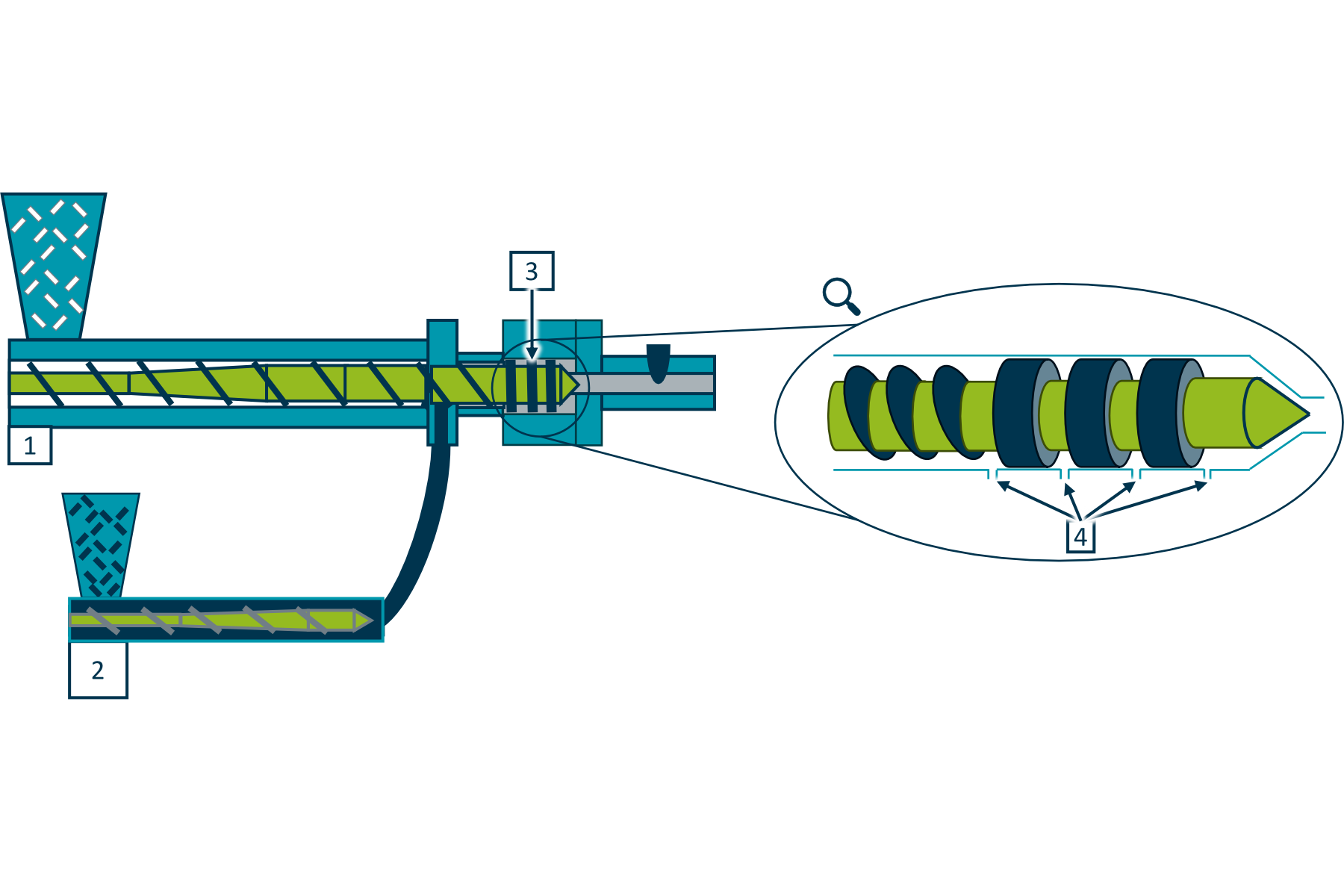
The dispersive mixing effect of mixing elements is particularly important for the breakdown of agglomerates or a second material phase, and thus significantly influences the homogeneity of the extruded melt. To analyze the exact factors influencing the dispersive mixing effect, experiments are being conducted using PP in a mixing section available at the IKV—a section consisting of several blister rings mounted on a 60-mm single-screw extruder and designed primarily for dispersive mixing. A second melt stream is introduced laterally into the mixing section: polystyrene (PS), which is incompatible with PP, or PP with a carbon black masterbatch. By varying the throughput, melt temperature, and the order of the blister rings, the secondary material is fragmented to varying degrees. Before and after each blister ring, side streams are sampled via radial capillaries. The extrudates are examined microscopically, with the size and size distribution of the PS and carbon black particles serving as indicators of the degree of dispersion. The evaluation is performed, for example, using grayscale analysis.
This work is related to this research project
The research project aims to robustly and automatically optimize blend components for single-screw extruders. This thesis is part of a work package in which a objective function for the degree of dispersion is being developed; this function will serve as the basis for automatic simulation-based optimization in subsequent work packages.
Objective
The objective of this thesis is to experimentally characterize the dispersive mixing effect as a function of process and geometric parameters. By taking samples along the mixing section, the development of the mixing effect across the individual blister rings will also be investigated.
Your Task
| For a bachelor's thesis, you will work on the following tasks | For a master's thesis, you will work on the following tasks |
| Familiarization with the function and design of single-screw extruders and their mixing elements | Investigation of additional process parameters |
| Construction and design of the experimental setup | Investigation of additional process parameters |
| Development of key metrics for evaluating mixing quality | Investigation of the influence of the blister ring sequence |
| Planning and conducting extrusion tests with PP and PS on the 60-mm single-screw extruder | |
| Microscopic examination of the extrudates | |
| Evaluation and interpretation of the results |
Your profile
- A degree in engineering or the natural sciences (e.g., mechanical engineering, industrial engineering with a specialization in mechanical engineering or materials and process engineering, automation engineering, computational engineering, or simulation sciences)
- Ability to work independently, conscientiously, and as part of a team
- Interest in experimental work
- Affinity for technology, creativity, and a willingness to learn
- Some experience with extrusion, design, microscopy, or statistical experimental design is desirable but not required
Here are your benefits
- Work in a young, motivated team
- Independent work with intensive support
- Co-design of current research projects
- Individual coordination of tasks and time frame
- Fast processing, direct contact for questions during processing
- Immediate start possible
If you are interested in writing a thesis at the IKV and in this research topic, please feel free to contact me. We will work out the exact scope of the thesis and the timeline on a case-by-case basis. There is also the option of working on a customized research topic using the OpenFOAM simulation software.