


Bachelor’s thesis and Master’s thesis
 © IKV
© IKVTopic of the work:
The PECVD process is used to deposit thin functional layers on plastic surfaces. Among other things, such layers can be used to specifically improve the barrier properties of plastic packaging against gases, water vapor, or other substances. This is particularly relevant for plastic bottles and plastic films, since materials such as PET, PP, or PE exhibit a certain degree of permeability to various substances. This permeability can be reduced by applying a suitable coating. This helps better protect sensitive contents, extend their shelf life, and reduce material usage.
The properties of the deposited layers are significantly influenced by the process parameters of the plasma process. These include, for example, the gas composition, the power input, the process pressure, the coating time, and the selected coating structure. Even small changes to these parameters can affect the layer structure, adhesion, and barrier properties. The careful selection of appropriate process parameters is therefore an important part of coating development.
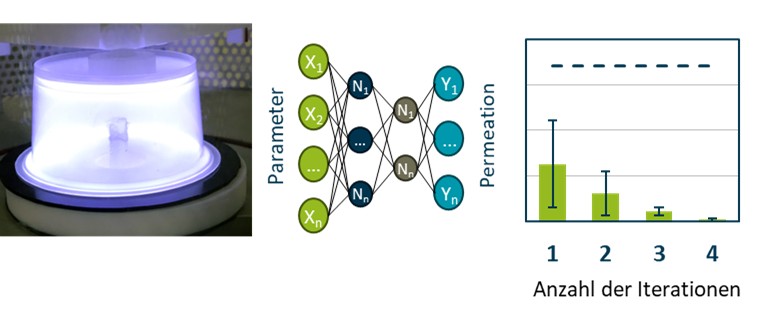
To date, the optimisation of PECVD coatings has been based on experimental design, empirical knowledge, and software-based approaches. Based on this, suitable process windows can be identified and layer properties can be specifically adjusted. A model-based approach is intended to expand this process by systematically evaluating process and analysis data and using it to select additional parameter combinations. This is intended to make layer development more efficient and provide better support in determining the appropriate process parameters.
The purpose of this thesis is to investigate the extent to which such a model can be used to optimise PECVD process parameters. To this end, plastic films are coated using process parameters selected and suggested by the model and are then analysed. The experimentally determined results will then be fed back into the model so that the parameters can be iteratively adjusted and further optimised. In this context, it is necessary to determine which model-based approach can be used to identify suitable process parameters more efficiently. The focus here is on the relationship between the coating process, layer structure, and the resulting properties of the coated plastic surfaces.
Your task:
| For a bachelor's thesis, you will address the following topics | For a master's thesis, you will address the following topics |
| Research on existing and potentially new modeling/software approaches | Research on existing and potentially new modeling/software approaches |
| Building a Model | Building a Model |
| Iterative layer deposition on a plastic film followed by analytical measurement (Coating thickness measurement + oxygen transmission measurement) | Iterative (higher number of iterations) coating deposition on one or two different plastic films and analytical measurements (coating thickness measurement, oxygen transmission measurement, additional analysis) |
| Comparison of Modeling Approaches | Comparison of Modeling Approaches, Evaluation of the Models |
Your profile:
- A degree in engineering or the natural sciences (mechanical engineering, industrial engineering with a focus on materials and process engineering or mechanical engineering, Computational Engineering Science (CES), Simulation Sciences, or materials science)
- Willingness to learn and familiarize yourself with new problems relating to plasma technology
- Independent and structured way of working
- Initial experience in a laboratory environment is desirable, but not necessary
- Programming skills
AG Plasma offers you a dynamic, young team in which you and your skills can grow during the course of your thesis, with clear objectives and diverse tasks. If you are interested in contributing to the field of plastics processing with your creative ideas, please feel free to get in touch with me!