


Bachelor’s Thesis or Master’s Thesis
 © IKV
© IKVTopic of the Thesis
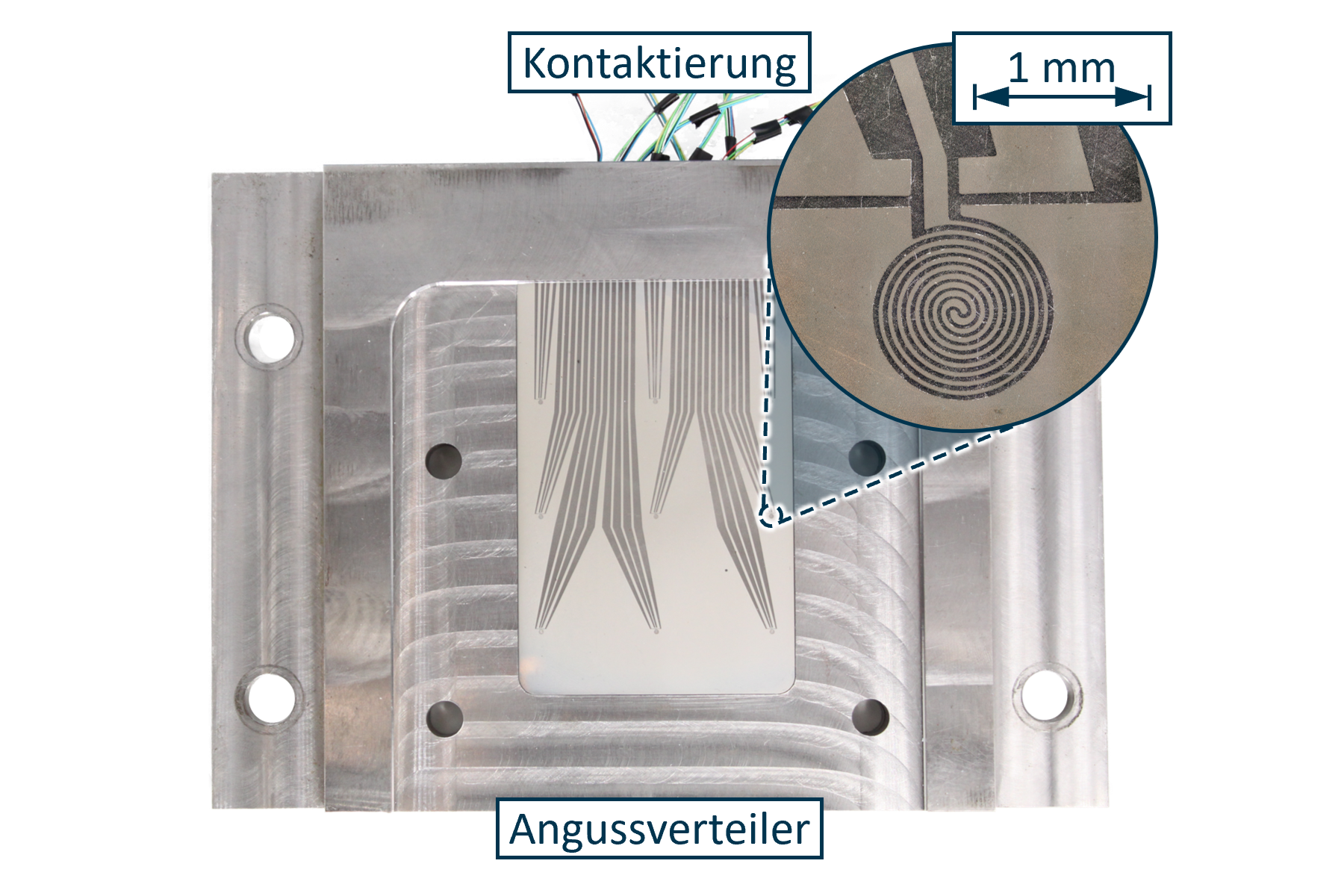
Conventional contact temperature sensors are relatively slow to respond, which makes it difficult to monitor the process. Furthermore, they provide only a single-point measurement. Coated mold surfaces in the form of thin-film sensors offer decisive advantages in this regard: They allow for the dense placement of individual measurement points at a distance of only about 500 nm from the melt. This provides new insights into the thermal behavior of injection molding with extremely high spatial and temporal resolution. Thus, thin-film sensors could make a decisive contribution to advanced temperature analysis. The only remaining question is whether the coating affects part quality or whether processability is actually improved by better flow properties at the mold surface.
This work is related to this research project
This work is being conducted as part of the “SITO” project, which aims to conduct a detailed investigation and modeling of weld seam formation while taking prevailing process conditions into account. To this end, a thin-film temperature sensor system is being developed in collaboration with Leibniz University in Hanover.
Objective
The goal of your work is to use existing thin-film sensors in injection molding and to examine the dimensional accuracy of the components produced using this method. Any shrinkage effects will be attributed to the residual stresses that develop within the component.
| For a bachelor's thesis, you will address the following tasks | For a master's thesis, you will address the following tasks |
| Designing the experimental setup for your injection molding tests (varying the process parameters and temperature sensors) | Designing the experimental setup for your injection molding tests (varying the process parameters and temperature sensors) |
| Conducting the injection molding experiments as a parameter study | Conducting the injection molding experiments as a parameter study |
| Analysis of the process influence of the sensor system on the properties of the manufactured test specimens using optical strain measurement and residual stress measurement via the borehole method | Evaluation of the recorded temperature profiles |
| Analysis of the influence of the sensor system on the properties of the manufactured test specimens using microscopy, optical strain measurement, and the borehole method |
- A degree in engineering or the natural sciences (Mechanical Engineering, Industrial Engineering (Mechanical Engineering or Materials and Process Engineering), Materials Science, Automation Engineering, or Computational Engineering Science (CES))
- Practical experience in plastics processing and measurement and sensor technology is helpful for getting started, but is not a requirement
- You should have a passion for plastics engineering. Depending on your area of study and interests, your work can be focused on design, simulation, or material characterization
These are your benefits
- Independent work with intensive guidance
- Active participation in current research projects
- Individual coordination of tasks and timelines
- Work can begin immediately
- Experimental work on industrial equipment
- Quick turnaround, direct contact for questions during the project
- A varied mix of research, experimental work, and analysis
If you’re interested in writing a thesis at the IKV and in this topic, please feel free to contact me. We’ll work out the exact scope and timeline together on an individual basis.