


Bachelor’s thesis or Master’s thesis
 © IKV
Topic of the Thesis
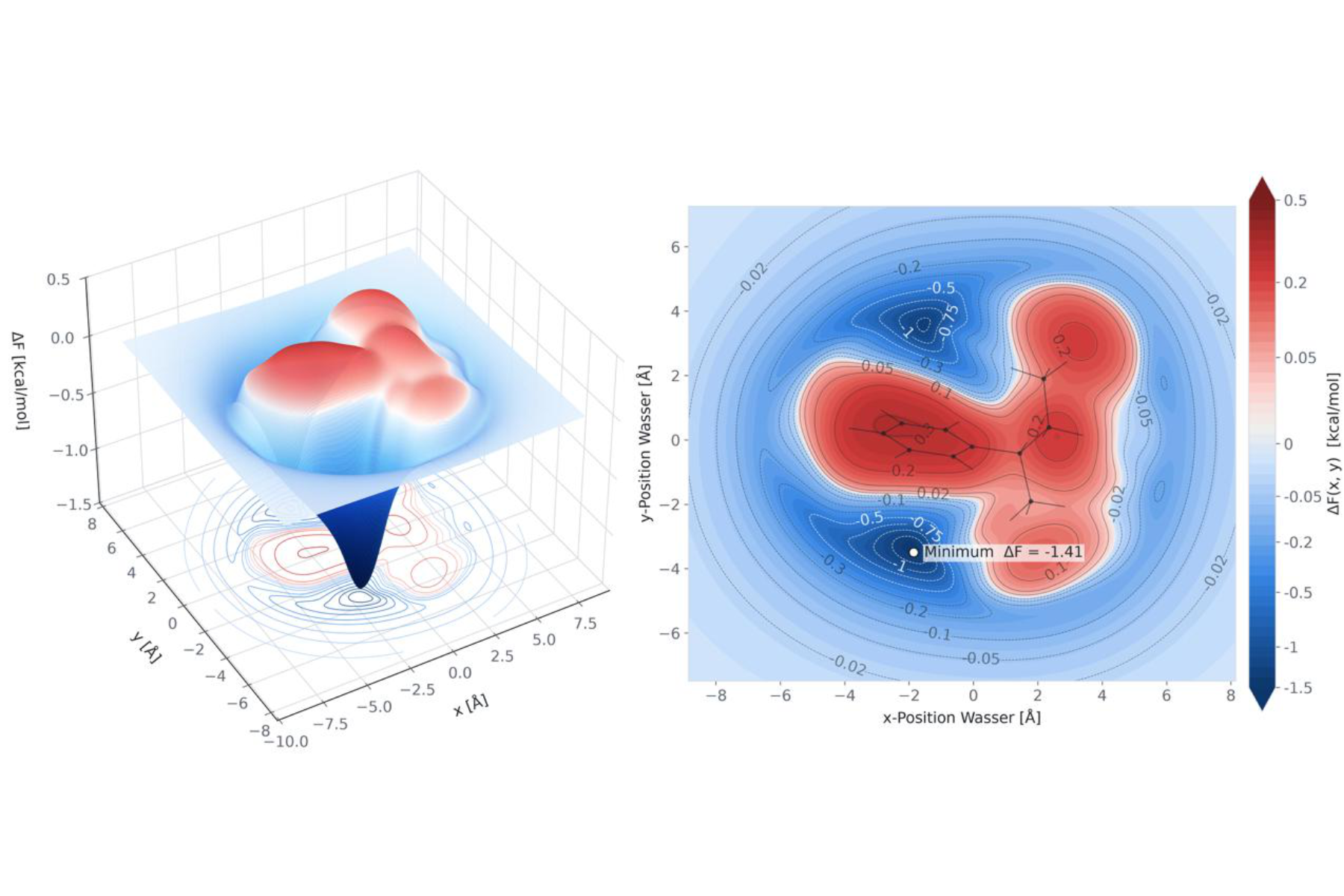
Whether a medium attacks a plastic is determined at the level of individual molecules. A quantum mechanical calculation provides a surprisingly meaningful quantity for this: namely, the energy difference between the interacting polymer/medium pair and the isolated molecules. At the IKV, this relationship has already been used to describe environmental stress cracking (ESC). The problem here is the computational effort involved, since each new combination requires a new calculation, and the number of possible combinations is practically unlimited. A model that predicts this energy directly from the molecular structure turns a computational task into a simple query.
The paper is being written by this research group
In the Media Influence Working Group, we follow the Quantitative Structure-Property Relationship (QSPR) approach. The goal is to infer the ESC risk from the molecular structure of the polymer and the medium. The interaction energy is one of the key parameters in this context, and the corresponding dataset is growing through a series of interrelated studies. Calculations are performed using the simulation environment available at the IKV and on the CLAIX high-performance computer at RWTH Aachen University.
Objective
To build a consistent dataset from ab initio calculations of polymer/medium combinations and to utilize this data to predict interaction energy based on molecular structure.
Your Responsibilities
| For a bachelor's thesis, you will work on the following tasks | For a master's thesis, you will work on the following tasks |
| Familiarization with the quantum mechanical calculation of interaction energies between polymers and the medium | Familiarization with the quantum mechanical calculation of interaction energies between polymers and the medium |
| Review and preparation of existing calculations, as well as the creation of a consistent dataset | Development of an automated calculation routine and systematic expansion of the dataset |
| Supplementing the dataset with your own calculations on the high-performance computer | Investigating suitable representations of the molecules and developing a model to predict the interaction energy |
| Description of molecules using appropriate parameters and analysis of their relationship to the interaction energy as a basis for subsequent modeling | Validation of predictions for combinations outside the training dataset and classification according to the ESC classification |
Your Profile
- A degree in a natural science or technical field (Mechanical Engineering, Industrial Engineering with a specialization in Mechanical Engineering, Plastics Engineering, or Materials and Process Engineering, Simulation Sciences, Materials Science, Computational Engineering Science (CES), Applied Chemistry, or Applied Polymer Science)
- Interest in chemistry, simulation, and data-driven methods
- Basic knowledge of Python is helpful but not required
- Willingness to learn new software and how to work on a high-performance computer
- An independent, structured, and team-oriented work style
Here are your benefits
- Work in a young, motivated team
- Independent work with close supervision
- Opportunity to help shape a research topic that will serve as the foundation for future work
- Individual coordination of tasks, scope, and timeframe
- Access to the CLAIX supercomputer at RWTH Aachen University
- A varied mix of research, simulation, and data analysis
- Can start immediately
If you’re interested in writing a thesis at the IKV and in this topic, please feel free to contact me. We’ll work together to determine which combinations you’ll investigate, how far the thesis will go in terms of modeling, and what the timeline will look like, so that the thesis aligns with your interests and prior knowledge.