


Development of a practical calculation method for describing the crash behavior of injection-molded thermoplastic foams, taking into account the degree of expansion and dependence on strain rate
Injection-moulded thermoplastic foams offer significant potential for lightweight design and, owing to their integral foam morphology, enable a substantial reduction in both component weight and material consumption. However, for reliable design under short-duration dynamic loading, industry still lacks a computational methodology that can capture the locally varying degree of foaming and the tension-compression asymmetry within the framework of conventional material models. The project TP Foam Crash aims to develop such a methodology.
 © IKV
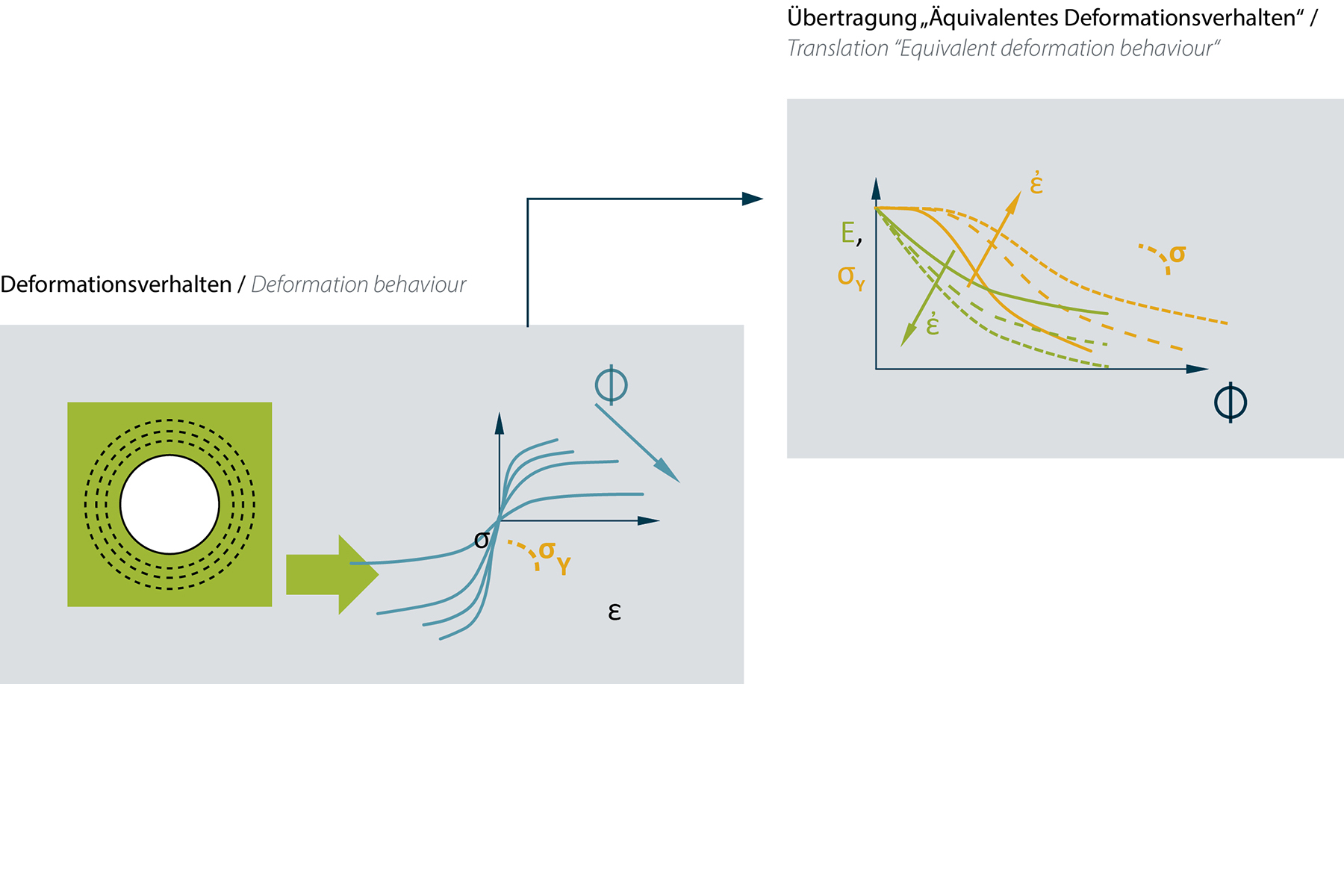
© IKVInitially, solid (compact) and foamed plates, as well as demonstrator components, will be manufactured using thermoplastic foam injection moulding. By varying the blowing-agent content, melt temperature, mould temperature, volumetric injection rate and plate thickness, a design of experiments will be implemented to capture how processing parameters affect foam morphology and mechanical response. The foam structure will be characterised locally using micrographs of prepared cross-sections and automated image analysis. In parallel, process simulations will be performed, with their predicted local degree of foaming calibrated against the measured density profiles.
On this basis, a micromechanical model will subsequently be developed in the form of a representative volume element with an idealised pore architecture. The constitutive behaviour of the compact thermoplastic will be described using a strain-rate-dependent Drucker–Prager model. By varying the degree of foaming and the strain rate, numerical stress–strain curves will be generated, from which foaming-dependent reduction functions for stiffness, yield stress and strength are to be derived. These functions will then underpin a calculation routine that translates existing material cards for compact polymers into equivalent datasets for integral-foam components.
Finally, the methodology will be validated on test plaques and representative component geometries under impact loading. This will result in a computational design approach that enables small and medium-sized enterprises, in particular, to design injection-moulded thermoplastic foams reliably with an acceptable level of calibration effort.
Project data and Funding
We would like to thank the BMWE for funding the IGF project (funding code 24650 N) and the project partners for their cooperation.
