


The objective of project PolyH2Pipe was the development and validation of continuous-fiber-reinforced thermoplastic pipe systems for media lines in electrolysers. To this end three sub-projects examined the requirements for the pipe systems, the materials used, and economic aspects in a first step. On this basis, manufacturing concepts for pipe designs with continuous-fiber-reinforced tape winding were developed and tailored to different pressure, temperature and media requirements.
 © IKV
© IKVFor the project, the suitability of low-cost materials such as PP and PE was evaluated. Components were constructed for both materials, that were reinforced with four and six layers, respectively, of glass-fiber-reinforced tape made from the same material. In addition, barrier coating systems based on amorphous hydrocarbon and silicon oxide were systematically developed to ensure the suitability of the pipe systems for use in hydrogen environments. (Sub-project 1: Design and development of manufacturing strategies for continuous-fiber-reinforced thermoplastic pipe systems for hydrogen applications)
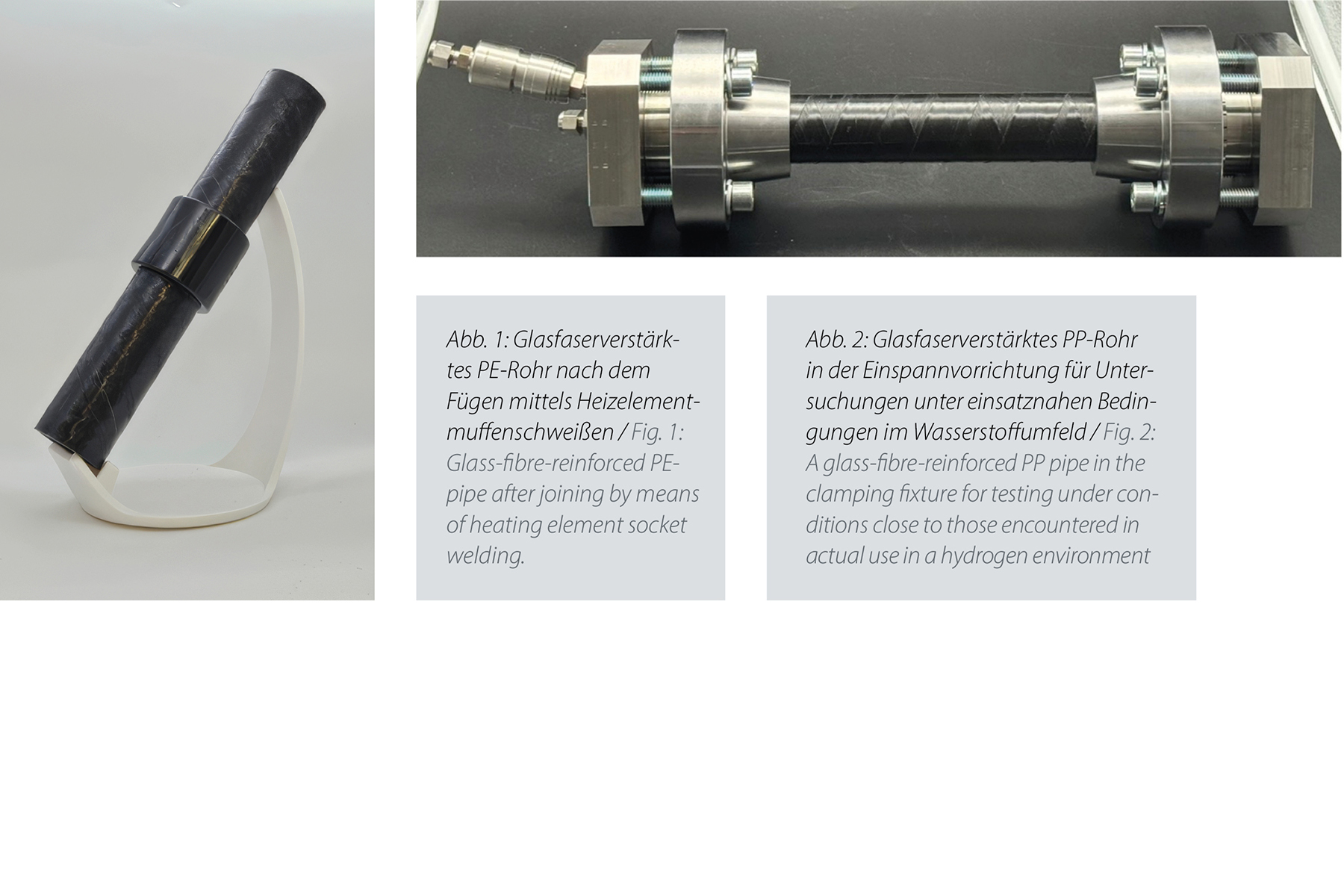
Building on this, suitable joining processes for these pipe systems were developed with the aim of not impairing their functionalities. For this purpose, heating element socket welding and adhesive bonding processes were selected. The resulting joints were evaluated using mechanical and analytical characteristics. In addition to plastic-plastic joints, plastic-metal joints were also investigated (Fig. 1). (Sub-project 2: Development of welding and bonding processes for plastic media lines for hydrogen applications)
Finally, methods and test benches were developed for the application-oriented validation of the pipe systems and joints. The aim was to characterise and test the pipe systems with regard to their permeation properties and pressure resistance under operating conditions (Fig. 2). (Sub-project 3: Methods for validating the requirements for plastic media piping in hydrogen applications).
Overall, the three subprojects demonstrated that a transferable technological basis for economical and validated plastic media lines in the hydrogen economy has been established.
Project data and Funding
We would like to thank the BMWE for funding the IGF project (funding code 63-65 N) and the project partners for their cooperation.
