


Methodology for the Automated Design and Validation of a Uniform Flow Front Path
Cascade injection moulding is the method of choice for parts with high surface quality requirements and large flow path/wall thickness ratios. Due to the complex interrelationships, particularly between the injection flow rate profile set on the machine and the interaction of the individual hot runner pin controls, the process setup is very complex and involves a large number of experimental tests.
 © IKV
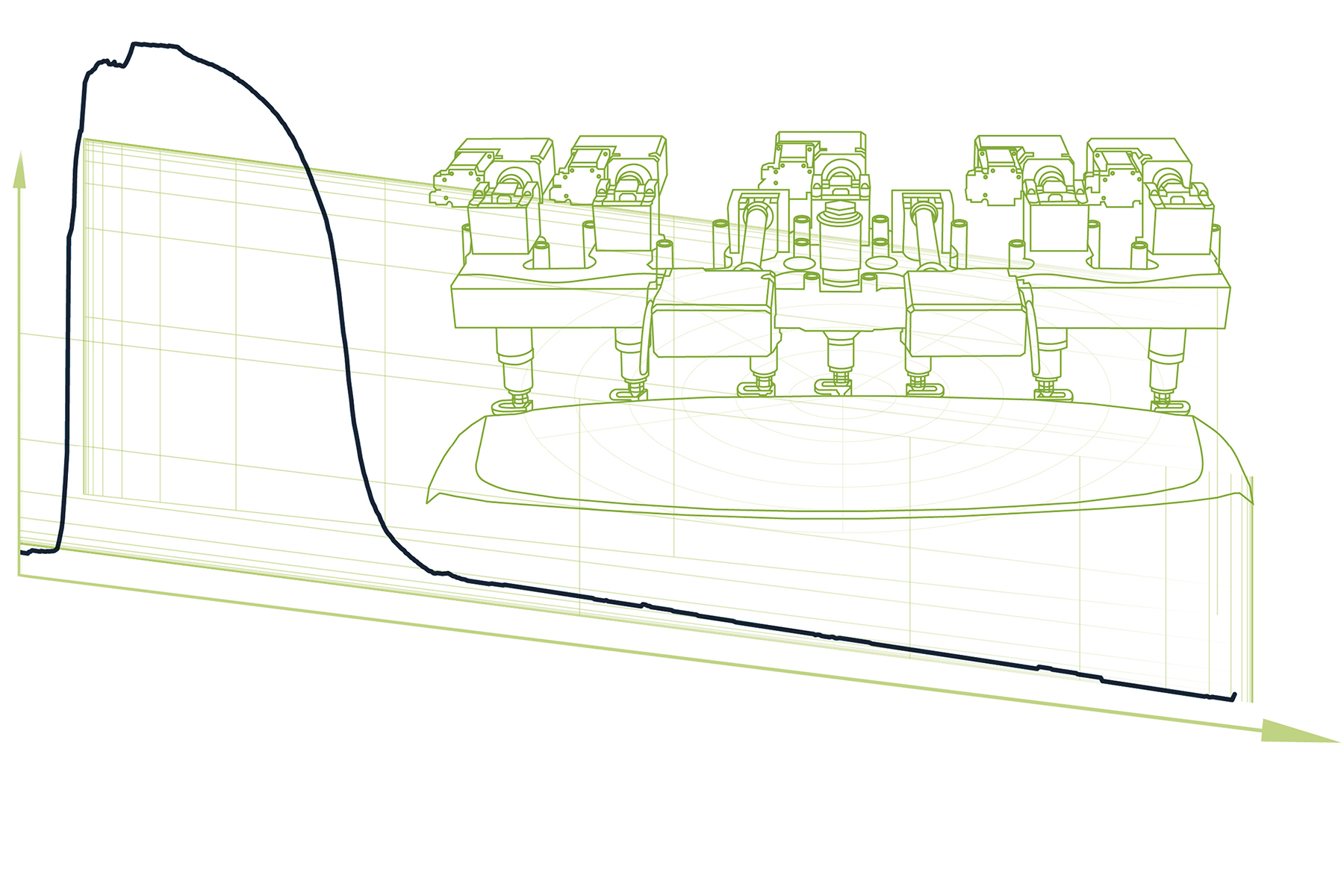
© IKVThe DFG funded OptiKas research project aims to develop a methodology for deriving an injection strategy for cascade injection moulding that delivers high-quality parts regardless of the machine operator’s experience and without the need for extensive testing. To achieve a consistently high surface quality along the entire flow path, a constant flow front velocity is to be maintained within the cavity.
As a first step, automated iterative simulations, that take the cascade into account, will be used to determine the gate-specific target injection volume flow profiles in order to achieve a constant target flow front velocity within the cavity. On this basis, a process model is used to calculate the individual valve gate pin stroke profiles and the machine side injection flow rate profile. The process model takes the interaction between the flow rates of the individual hot runner gates into account. The injection strategy developed is validated and optimised through experimental trials for different geometries, material types and process settings. Furthermore, the effect of the injection strategy on surface quality, such as gloss, roughness and molecular orientation in the surface layer, is investigated.
To conclude the project, the robustness of the process against process fluctuations will be analysed in order to derive key performance indicators for monitoring the filling phase of cascade injection moulding. Furthermore, the potential effect of an adaptive control strategy will be assessed on the basis of the experiments.
Project data and Funding
We would like to thank the DFG for funding this project (grant number: HO 4776/102-1) and our project partners for their collaboration.
