


Multiscale simulation for more accurate prediction of shrinkage and warpage in partially crystalline components
For manufacturers of precision injection-molded parts, reliable warpage prediction is essential to reduce rejected parts, shorten try-out phases, and improve dimensional accuracy. In semi-crystalline polymers, macroscopic pvT-based shrinkage models alone are often not sufficient to reliably predict post-molding warpage. This is because local thermal and pressure histories create gradients in crystallization, resulting in locally anisotropic thermo-mechanical properties across the injection-molded part.
 © IKV
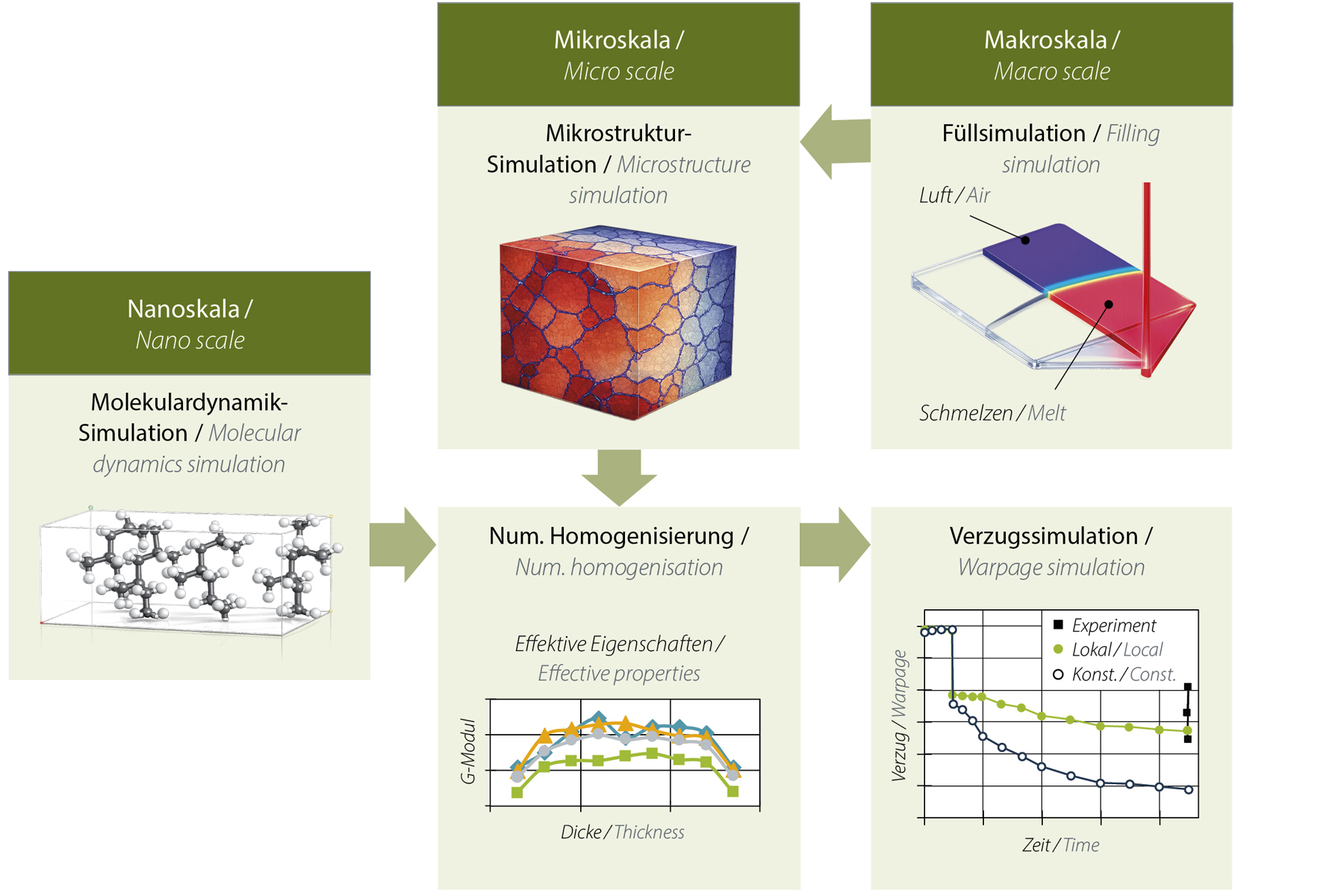
© IKVIn this subproject of SFB 1120, the IKV developed an integrated multiscale simulation framework to improve the thermo-mechanical warpage analysis of semi-crystalline parts. The approach couples non-isothermal filling simulation with hierarchical multiscale crystallization and material modeling. This approach captures how local cooling conditions affect crystallization degree, effective properties, and final part distortion.
The results from a stepped-plate benchmark show that considering local crystallization-dependent properties is necessary to reliable predict warpage and shrinkage. Compared with a constant-property description, the prediction accuracy improved by approximately a factor of six, confirming the industrial value of process-structure-property based simulation.
General Information on the SFB
Since 2014, Collaborative Research Center 1120 at RWTH Aachen University has been researching new scientific approaches and technologies for controlling processes in which the material passes through a molten phase in order to precisely manufacture the geometry. Next to metal welding, casting, and joining processes, the IKV conducted research on plastic injection molding as part of this large-scale project through three subprojects. Through the design of temperature cooling channel layouts, dynamic mold temperature control and multiscale process simulations, the project investigated melt dynamics, solidification, and methods for influencing or modeling these phenomena at various levels.
Project data and Funding
Project data and Funding
We would like to thank the DFG for funding this project as part of Collaborative Research Center 1120 and our project partners for their collaboration.
