


Data-Driven In-Line Prediction and Adaptive Formulation Adjustment to Stabilize Melt Viscosity
The increasing use of post-consumer recyclates (PCR) significantly raises the complexity of processing processes, as the material properties of PCR can vary considerably from batch to batch. In particular, fluctuations in viscosity present substantial challenges, requiring continuous adjustment of existing polymer processing procedures. Within the ViscAssist project, a data-driven assistance system was therefore developed to predict the viscosity of polymer melts in-line during the compounding process and, based on this, to propose suitable formulation adjustments aimed at achieving a viscosity as constant as possible. This, in turn, facilitates more stable downstream processing.
 © IKV
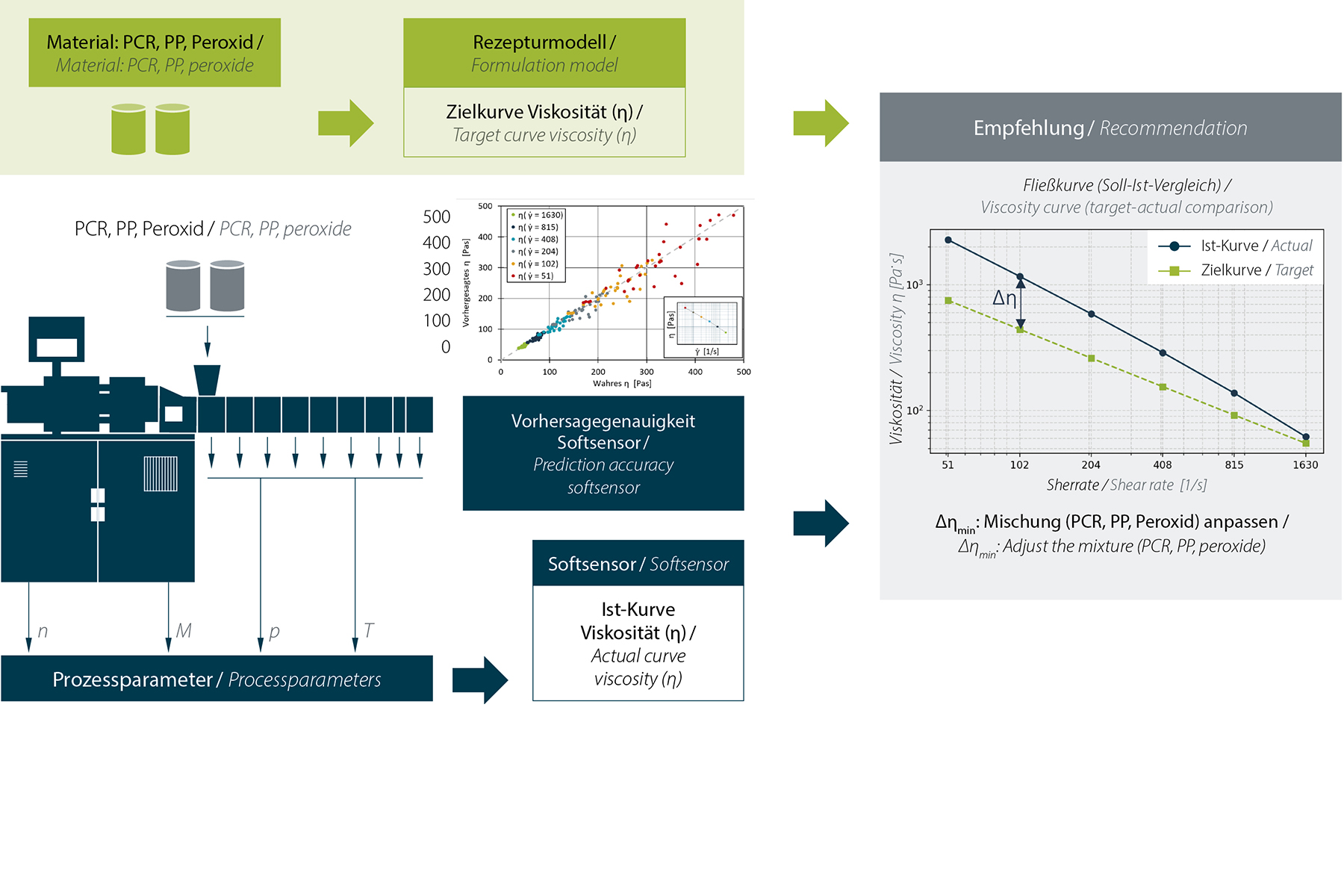
© IKVInitially, a soft sensor designed as a neural network was developed for in-line prediction, which estimates the viscosity curve from process parameters including screw speed, pressure, temperature, and torque. In addition, a formulation-based model was created to describe the influence of material composition on viscosity using established mixing rules. The dataset comprises 120 polypropylene compounds with varying polymer and PCR types (MFR 3.5 – 47 g/10 min), as well as different peroxide contents.
By combining both models, the current actual viscosity curve can be determined from process data using the soft sensor and compared with a target curve calculated from the mixing rules. Based on this comparison, a recommendation model derives targeted adjustments to material proportions in order to approach the target curve. For known formulations, the actual viscosity can be predicted with an R2 of 0.92, while the formulation model achieves an R2 of 0.98. The recommendation model is currently undergoing practical testing and has so far produced plausible recommendations.
The assistance system is intended to detect viscosity fluctuations in the compound and provide recommendations for adjusting the formulation. This enables more homogeneous material properties for subsequent processing steps, thereby supporting more efficient and sustainable production.
Project data and Funding
We would like to thank the BMWE for funding the IGF project (grant number 23179 N) and our project partners for their collaboration.
