Digitalisation methods for optimising the sustainability in plastic material cycles
To this end, the material technology options and challenges of plastics processing were combined with the ecological assessment of the products. A digital cooperation network has been developed as the basis for the exchange of data along the entire value chain. Together with partners from research and industry (Manufacturing Technology Institute der RWTH Aachen (MTI), Arburg GmbH + Co KG, Brückner Maschinenbau GmbH, Carbon Minds GmbH, Henkel AG & Co. KGaA, Interzero Circular Solutions Germany GmbH, Pöppelmann GmbH & Co. KG, Kunststoff-Werkzeugbau, Reifenhäuser GmbH & Co. KG Maschinenfabrik, Reifenhäuser Blown Film GmbH), a demonstrator was developed and produced, consisting of a PE film laminate with an injection-moulded PE spout (Fig. 1). The achieved PCR content was more than 60 %. In order to meet the challenges in recyclate processing, extensive process and material analyses were carried out at IKV in both injection moulding and extrusion.
 © IKV
© IKVIn the field of injection moulding, IKV dealt with process engineering issues relating to the drying and ageing of recyclates, mixing behaviour with virgin material and seasonal fluctuations. Both process stability and component quality were evaluated. The combination of recyclates with virgin material in particular offers great potential for increasing recyclate utilisation rates in the short term. IKV therefore analysed the properties of such mixtures of recyclate and virgin material for PE and PP, and investigated their behaviour in the injection moulding process. The rheological, physical, mechanical and morphological properties of various PCR material qualities were evaluated and correlated with conventional parameters. The influence on the injection moulding process was analysed so that recommendations for the processing of PCR materials could be derived.
The work of the Extrusion department was centred on process engineering and analytical issues relating to the composition and ageing of recyclates, the reduction of specks and seasonal fluctuations that are relevant to film extrusion. The effects of different recyclates on processabiltiy and functional properties of films were assessed. The challenge in the film extrusion of commercially available recyclates is in particular the formation of specks, which has a negative impact on the extrusion process (e. g. tearing of the film sheet) and the possibilities of further processing (e. g. printing, laminating), as well as on the mechanical properties.
 © IKV
© IKVExamples of specks in a blown film are shown in Figure 2. Investigations have shown that around 30 % of the gels analysed are sharp-edged, cross-linked polyethylene-based particles. The composition of the recyclates in particular, which may contain PP components in PE, compatibilisers or stabilisers, for example, has a major influence on the formation of specks. It was therefore identified as a starting point for the development of recyclable material compounds. In order to further investigate the ageing mechanisms of typical film compounds, recyclates were analysed using high-temperature gel permeation chromatography (HT-GPC). The properties of different PCR material qualities were evaluated to categorise the recyclability of film compounds. In addition, the influence on the blown film process was analysed and recommendations for the processing of PCR materials derived.
 © IKV
© IKV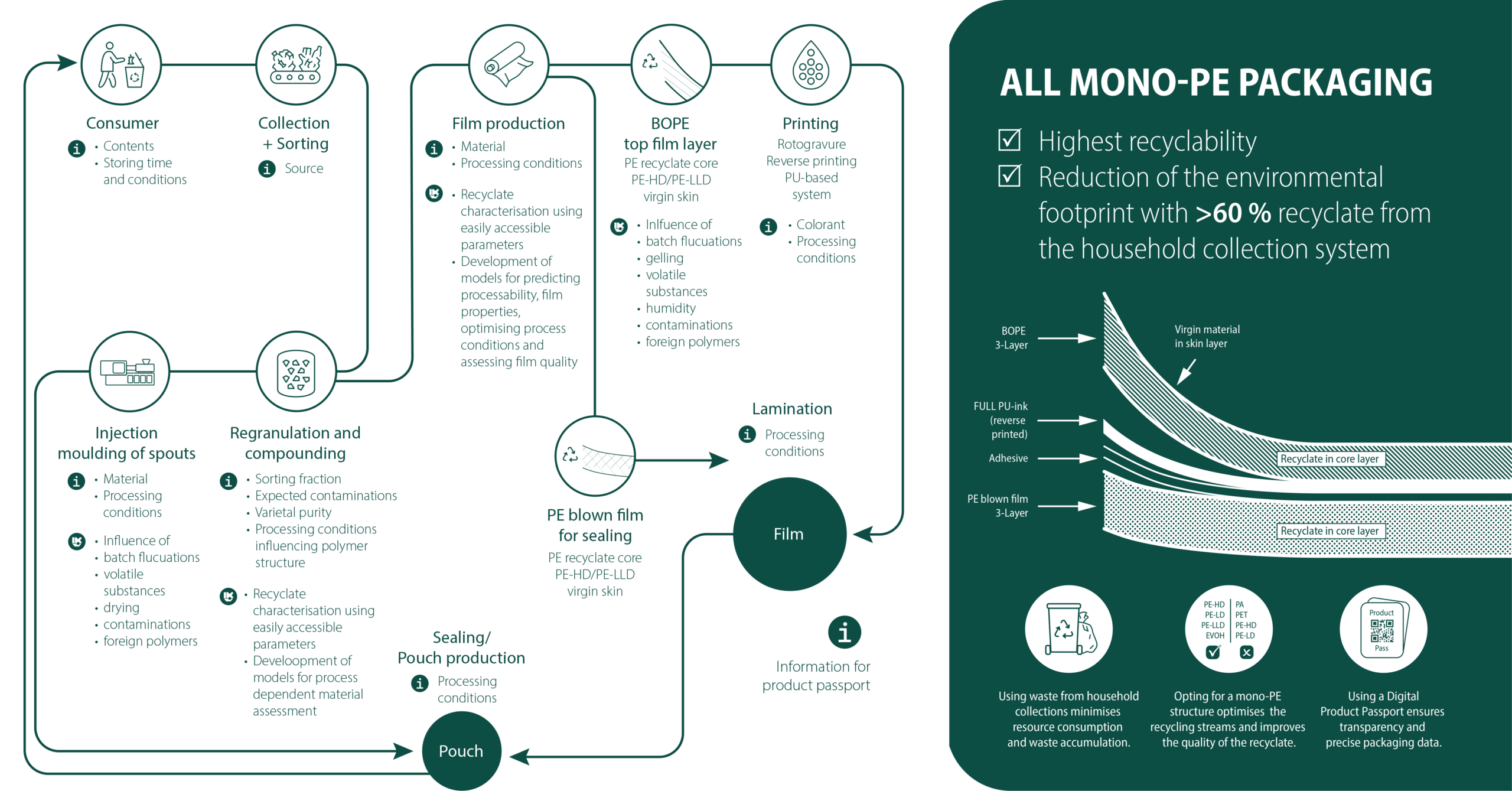
Final Report
 © Springer Nature
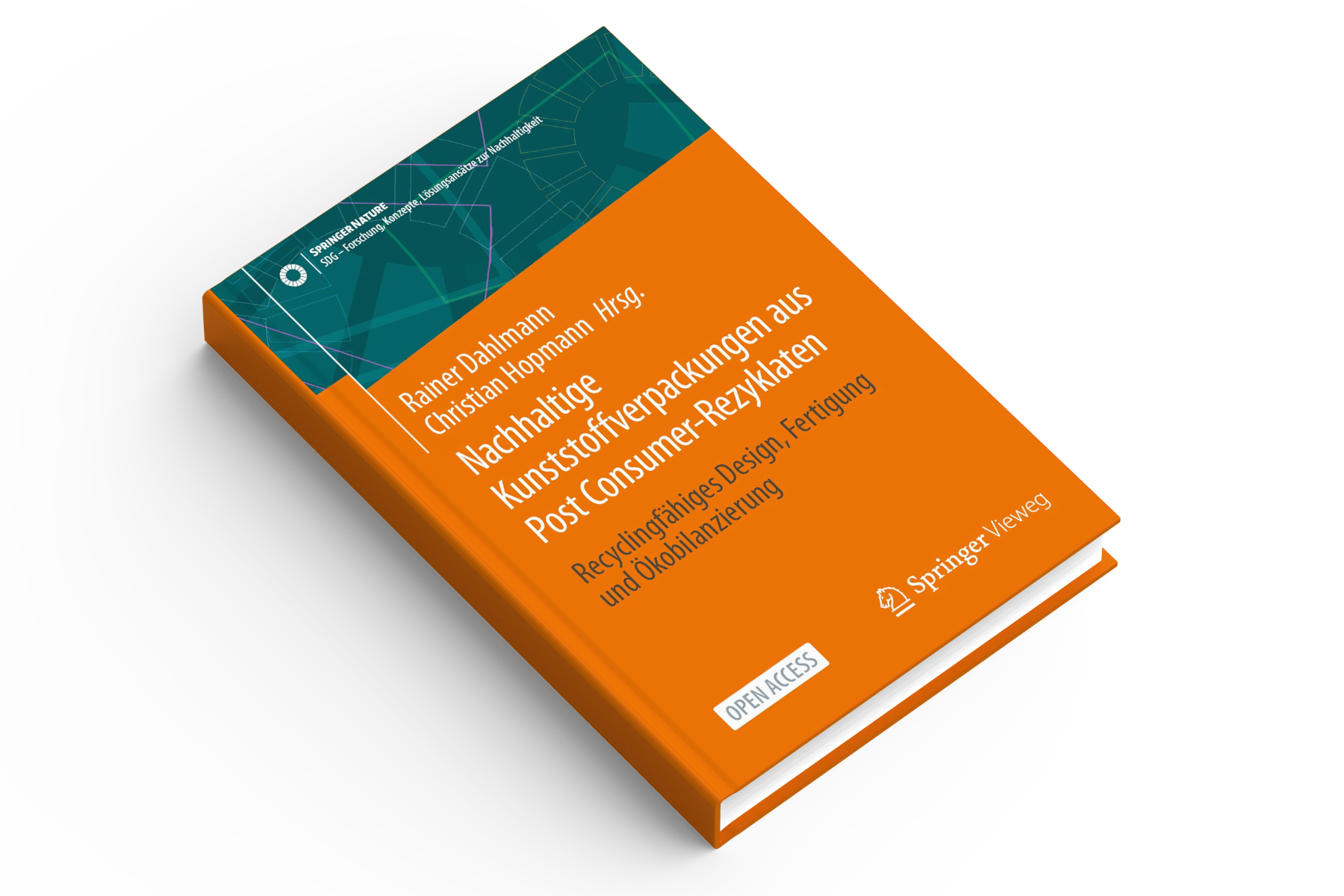
Sustainable plastic packaging made from post-consumer recycled materials
Recyclable design, manufacturing and life cycle assessment
This book explores the complex question of how digital technologies can contribute to the creation of transparent and efficient circular systems for plastic packaging. The underlying research project, ‘PlasticBOND’, adopted an interdisciplinary research approach that combines three key areas: the assessment of environmental sustainability, the development of digital collaboration models within value chains, and the use of digital tools to create transparency regarding the potential applications of recycled materials in plastic packaging.
On the one hand, the project focused on the systematic analysis of plastic packaging and the recycled materials derived from it. Extensive test series were conducted to analyse how commercially available post-consumer recycled materials from the German „Yellow Bag“ perform in standard processing methods such as extrusion and injection moulding, and what properties the products manufactured from them exhibit. On the other hand, a comprehensive assessment of packaging was carried out at a data-driven level – from production through
use to disposal and recycling. This took into account not only the environmental impacts, such as energy consumption and CO2 emissions, but also the economic and social dimensions of a sustainable circular economy.
The paper has been published as open access and is available online free of charge:
https://link.springer.com/book/10.1007/978-3-658-48211-4
We carried out this project in collaboration with the following consortium partners. We would like to express our sincere thanks for their cooperation and support!


Project data and funding
We would like to thank the BMBF (BMFTR since 6.5.2026) for funding the project (funding reference 02J20E540) and the project partners for their cooperation.
Project duration: 01.07.2021 – 30.09.2024
Promotion: